How to Identify PII in 2026: Complete Guide to Personally Identifiable Information
Learn what PII is, how to identify it in your data, and why PII redaction is critical for AI tool users in 2026.
How to Identify PII in 2026: The Complete Guide to Personally Identifiable Information
In an era where AI-related data leaks have increased 400% since 2023, understanding what constitutes Personally Identifiable Information (PII) has become essential for every knowledge worker, developer, and business professional. Whether you're drafting emails, debugging code, or using ChatGPT for productivity, the ability to identify PII before it reaches the wrong hands can mean the difference between secure operations and catastrophic data breaches.
This comprehensive guide teaches you how to identify PII in any dataset, understand the legal implications of PII handling, and implement effective redaction strategies that keep you compliant with regulations while maintaining data utility.
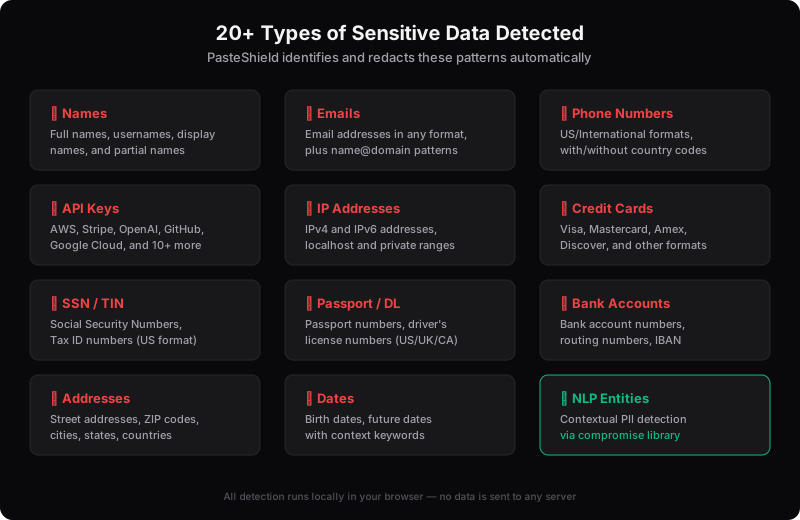
What Is PII? Understanding the Fundamentals
Personally Identifiable Information (PII) is any data that can be used to identify, contact, or locate a specific individual. The definition has evolved significantly over the past decade, and in 2026, PII extends far beyond traditional fields like names and email addresses.
The US National Institute of Standards and Technology (NIST) defines PII as "any representation of information that permits the identity of an individual to whom the information applies to be reasonably inferred or substituted by any direct or indirect means." This broad definition captures the modern reality: even seemingly innocuous data points can become PII when combined.
The Two Tiers of PII: Linked vs. Linkable
Sensitive PII (Linked)
Sensitive PII is information that directly identifies an individual and requires strict protection:
- Full name (first, middle, last)
- Social Security Number (SSN) or national ID numbers
- Driver's license number
- Passport number
- Financial account numbers (bank accounts, credit cards)
- Medical record numbers
- Biometric data (fingerprints, facial geometry, iris scans)
- Date of birth combined with birthplace
Non-Sensitive PII (Linkable)
Non-sensitive PII cannot identify someone on its own but can when combined with other information:
- Zip code
- Gender
- Race or ethnicity
- Age
- Occupation
- Email address
- Phone number
- IP address
The critical insight: non-sensitive PII becomes sensitive when linked. An email address alone might not identify you, but combined with your name, company, and role, it creates a complete identity profile.
The 10 Categories of PII You Must Identify in 2026
1. Direct Identifiers
Information that uniquely identifies a specific individual:
- Full legal name
- Social Security Number (SSN)
- Passport number
- Driver's license number
- Tax ID numbers (TFN in Australia, NI in UK)
- Employee ID numbers
- Patient ID numbers
2. Contact Information
Ways to reach or locate someone:
- Email addresses (personal and work)
- Phone numbers (mobile, landline, work)
- Physical addresses (home, work, billing)
- IP addresses (can locate to ISP region)
- MAC addresses (device identifiers)
3. Financial Identifiers
Information related to financial accounts and transactions:
- Bank account numbers
- Credit card numbers (even last 4 digits)
- CVV codes
- Expiration dates
- Transaction IDs
- Payment account credentials
4. Medical & Health Information
Protected health information (PHI) under HIPAA:
- Medical record numbers
- Health plan beneficiary numbers
- Prescription numbers
- Diagnosis codes
- Health insurance information
- Mental health records
5. Biometric Data
Physical and behavioral characteristics:
- Fingerprints
- Facial geometry
- Retina scans
- Voice prints
- DNA
6. Technical Identifiers
Digital traces and technical markers:
- IP addresses
- Device identifiers (UUID, MAC)
- Cookie IDs
- Login usernames
- Account numbers
7. Authentication Credentials
Secrets used for authentication:
- Passwords
- API keys
- OAuth tokens
- SSH keys
- Private keys
- JWT tokens
8. Infrastructure Information
Details that reveal system architecture:
- Internal IP addresses (10.x.x.x, 192.168.x.x)
- Private hostnames
- Database connection strings
- AWS resource identifiers
9. Behavioral Data
Information about actions and patterns:
- Browsing history
- Location data (GPS, cell towers)
- Purchase history
- Communication patterns
10. Derived & Composite PII
Information that becomes identifying when combined:
- Name + company + role
- Age + gender + zip code
- Device ID + timestamp + location
How to Identify PII in Practice: A Systematic Approach
Step 1: Know Your Regulations
Different jurisdictions define PII differently and impose different requirements:
- GDPR (EU): Any information relating to an identified or identifiable person
- CCPA (California): Information that identifies, relates to, or could be linked with a consumer
- HIPAA (US Health): Protected Health Information (PHI)
- Privacy Act (Australia): Personal information about an individual
Step 2: Scan for Common PII Patterns
Use automated tools to detect known formats:
- Emails:
name@domain.com - Phone numbers: Various formats (+1, (555), international)
- SSN: XXX-XX-XXXX pattern
- Credit cards: 13-19 digit sequences
- API keys: Prefixed strings like
sk_live_,AKIA,AIza
Step 3: Use NLP for Context-Dependent PII
Pattern matching finds structured data, but names and organizations require Natural Language Processing (NLP). Names appear in contexts like:
- "Contact: John Smith"
- "Sent to: alice@example.com"
- "Customer ID: 12345"
- Signatures and email headers
Step 4: Consider Linkability
Ask: "Can this data identify someone when combined with other available information?" If yes, treat it as PII even if it seems innocuous alone.
Why PII Identification Matters for AI Tool Users
In 2026, the average knowledge worker uses 3-5 AI tools daily. Each paste is a potential data leak. Consider what's in your clipboard:
- Debug logs containing customer emails and IPs
- Error messages with database connection strings
- Code snippets with hardcoded API keys
- Support tickets with customer personal details
- Documents with internal company information
A single accidental paste can transmit:
- Customer PII to AI training data
- Corporate secrets to competitors
- API keys that compromise production systems
- Compliance violations under GDPR, HIPAA, or PCI-DSS
The PII Identification Checklist for AI Tool Users
Before pasting anything to an AI tool, check for these red flags:
- Names (personal or corporate)
- Email addresses
- Phone numbers
- Physical addresses
- IP addresses (especially internal ranges)
- API keys or tokens
- Passwords or secrets
- Credit card information
- Government ID numbers
- Date of birth
- Medical information
- Financial account details
- Database credentials
- Private keys or certificates
- Internal hostnames or URLs
How to Redact PII: Context-Preserving vs. Generic
Context-Preserving Redaction
For analytical data that the AI needs to understand:
- "John Smith" → "[PERSON_1]"
- "acme@example.com" → "[EMAIL_1]"
- "555-123-4567" → "[PHONE_1]"
Generic Redaction
For security data that should never be revealed:
- "AKIAIOSFODNN7EXAMPLE" → "[REDACTED_AWS_KEY]"
- "sk_live_abc123xyz" → "[REDACTED_STRIPE_KEY]"
- "10.0.0.25" → "[REDACTED_IPv4]"
FAQ: Common Questions About PII Identification
Q: Does an IP address count as PII?
Yes, in most jurisdictions. The GDPR Court of Justice ruling established that IP addresses are personal data when they can be linked to an individual (through ISP records or cookies). Treat all IP addresses as PII.
Q: Is a username considered PII?
It depends. A username alone may not identify someone, but combined with other information (company, role, activity), it can. When in doubt, redact.
Q: What about anonymized or pseudonymous data?
Data is only truly anonymized if it cannot be re-identified, even with additional information. Studies show that 87% of Americans can be identified by just {ZIP code, gender, date of birth}. Most "anonymized" datasets aren't truly anonymous.
Q: Do I need to redact information that AI tools claim not to use for training?
Yes. Even if AI providers claim to not train on your data, they may still:
- Store data for debugging or safety monitoring
- Process data through third-party services
- Retain data for legal compliance
- Experience security breaches
Conclusion: Make PII Identification Second Nature
In 2026, data privacy isn't just an IT concern—it's every knowledge worker's responsibility. The ability to identify PII before pasting to AI tools is a fundamental skill that protects:
- Your customers' personal information
- Your company's intellectual property
- Your own professional reputation
- Your organization from regulatory penalties
Use automated tools like PasteShield to identify and redact PII before it reaches AI systems. The 30 seconds you spend sanitizing data can prevent years of compliance headaches, reputational damage, and financial losses.
When in doubt, redact it out. Your future self will thank you.
Found this guide helpful?
Share it with your team to spread AI privacy awareness.